
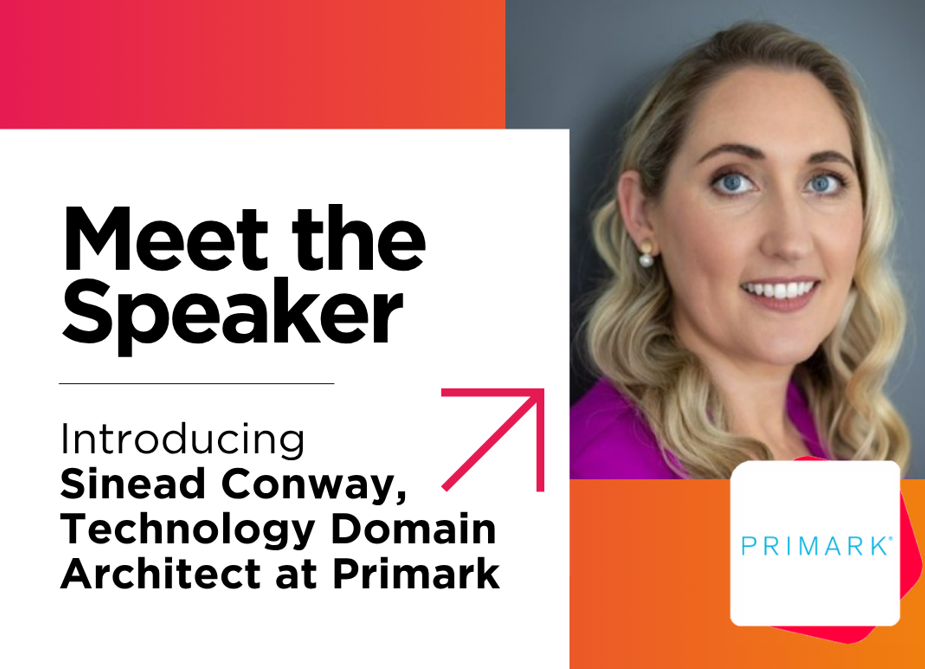
What has been the biggest shift in customer expectations over the last 12 months, and how has your team responded?
As Architects, our direct customers are Primark’s brilliant business teams, who are working to deliver commercial results and products customers love in an increasingly challenging environment. Soft retail conditions, geopolitical instability, and growing legislative demands make it more important than ever to use technology to help those teams stay competitive.
Retail has always moved fast, but the biggest shift is how quickly our team now needs to respond to business challenges. The rise of AI-enabled software has made point solutions far more attractive to business users than waiting for slower strategic implementations. This creates a healthy tension between taking tactical steps now and building toward long-term strategic goals in a coherent technology landscape. That makes strong relationships between Architecture and business stakeholders more important than ever.
My team supports our business partners in taking pragmatic, considered steps forward rather than imposing ivory tower ideals disconnected from the reality they face. Governance, principles, and guardrails are a vital part of an Architect’s role, but they lose effectiveness and relevance if we do not meet teams where they are. Relevance is earned by helping the business navigate immediate challenges with pragmatism and care, even when the answer is not perfectly strategic. In doing so, we build the relationships and trust that enable Architecture to exert stronger influence when the most important decisions need to be made.
As retail capabilities become increasingly unified across stores, digital, and social endpoints, where are you looking most for external architectural insight or innovation?
To create a joined-up experience across stores, digital, and social channels, the real work has to start in the foundations. I’m particularly interested in how other industries architect for speed without losing control of the core, and what retail can learn from that, for example, from highly regulated sectors such as pharmaceuticals, where traceability and compliance are designed in from the outset. Those disciplines are becoming increasingly relevant in retail as expectations grow around product transparency, provenance, and compliance across the value chain.
For Enterprise Architecture, looking outward is about finding practical patterns that help the business move at different speeds without creating fragmentation or unnecessary technical debt. My team and I focus on three things:
- Core and edge: how we keep core platforms stable, secure, and standardised (you can have any flavour you want as long as it’s vanilla!), while creating modular, API-led layers that allow customer-facing capabilities to evolve more quickly, including selectively adopting best-of-breed solutions for differentiating capabilities at the edge (this is where you get to add sprinkles!).
- Data flow: how we enable trusted, near real-time data to move across legacy platforms and modern digital channels, so information is consistent, reusable, and not trapped in silos.
- Practical use of AI: how we apply AI in focused, high-value use cases to remove friction and improve decision-making now, while longer-term strategic capabilities continue to mature.
It’s not about chasing the latest trend. It’s about building an architecture that is modular, resilient, and ready to adapt, giving the business room to move quickly while protecting the stability of the wider technology landscape.
What’s a long-held assumption about retail, customer experience, or technology that you’ve changed your mind on recently?
For a long time, I quietly assumed that somewhere out there, other organisations had already cracked the code, that the biggest vendors, leading retailers, and industry experts were operating from a playbook the rest of us were still trying to find.
More recently, my perspective has shifted. Through honest conversations with industry peers, partners, and vendors, I’ve realised that very few organisations have it all figured out. Most of us are navigating the same challenges: untangling legacy complexity, keeping pace with a fast-moving technology landscape, and helping our businesses adapt in constant change.
In many ways, the playing field is more level than it first appears, not because anyone has all the answers, but because the complexity is shared. That is what makes events like Retail Jam so valuable, they give us the chance to solve real problems together, as a community of peers, and to recognise the power in learning in real time.
Where are you currently balancing the need to innovate quickly with the realities of operating at scale across a large retail business?
Balancing the needs of today with the demands of tomorrow is one of the biggest acts of judgement in a large retail business. Right now, for us, that balance sits at the intersection of flexible architecture and pragmatic AI experimentation. In the past, building bespoke solutions at scale was often too expensive to justify.
Today, that has changed. With more flexible partner models and modern AI capabilities, it is now far more viable to build targeted solutions that remove immediate friction and create value quickly. But just because we can build more quickly does not mean we should build everything.
The real challenge is not cost; it is longevity. We have to be disciplined about where rapid builds genuinely make sense. If we are not careful, fast AI-led development can create a new kind of technical debt, solutions that solve a problem today, but become expensive and complex to support over time. Our approach is to think about this in two horizons. First, tactical speed: using focused, short-life solutions to prove value, reduce friction, and meet immediate business needs. Second, strategic scale: making sure those tactical solutions are understood as bridges, not destinations, and are replaced over time by more durable strategic capabilities with the right long-term support model.